
BloxFi Strategic Research Series
Stablecoin payment infrastructure: the hidden problem behind corporate adoption
A stablecoin transfer can settle in minutes. A business payment also has to be collected, converted, paid out in local currency and reconciled, and that is where most of the cost and delay still sit.
Payments infrastructure · November 2026 · 11 min read
From stablecoin interest to business use
Businesses are the largest users of stablecoins for payments, and the amounts are still small. McKinsey and Artemis Analytics estimate that actual stablecoin payments run at about $390bn a year, roughly 0.02% of global payment volumes. Business-to-business payments are the largest part, at about $226bn. The same analysis notes that raw transaction volume of up to $35tn a year is mostly trading, internal fund movements and automated activity.
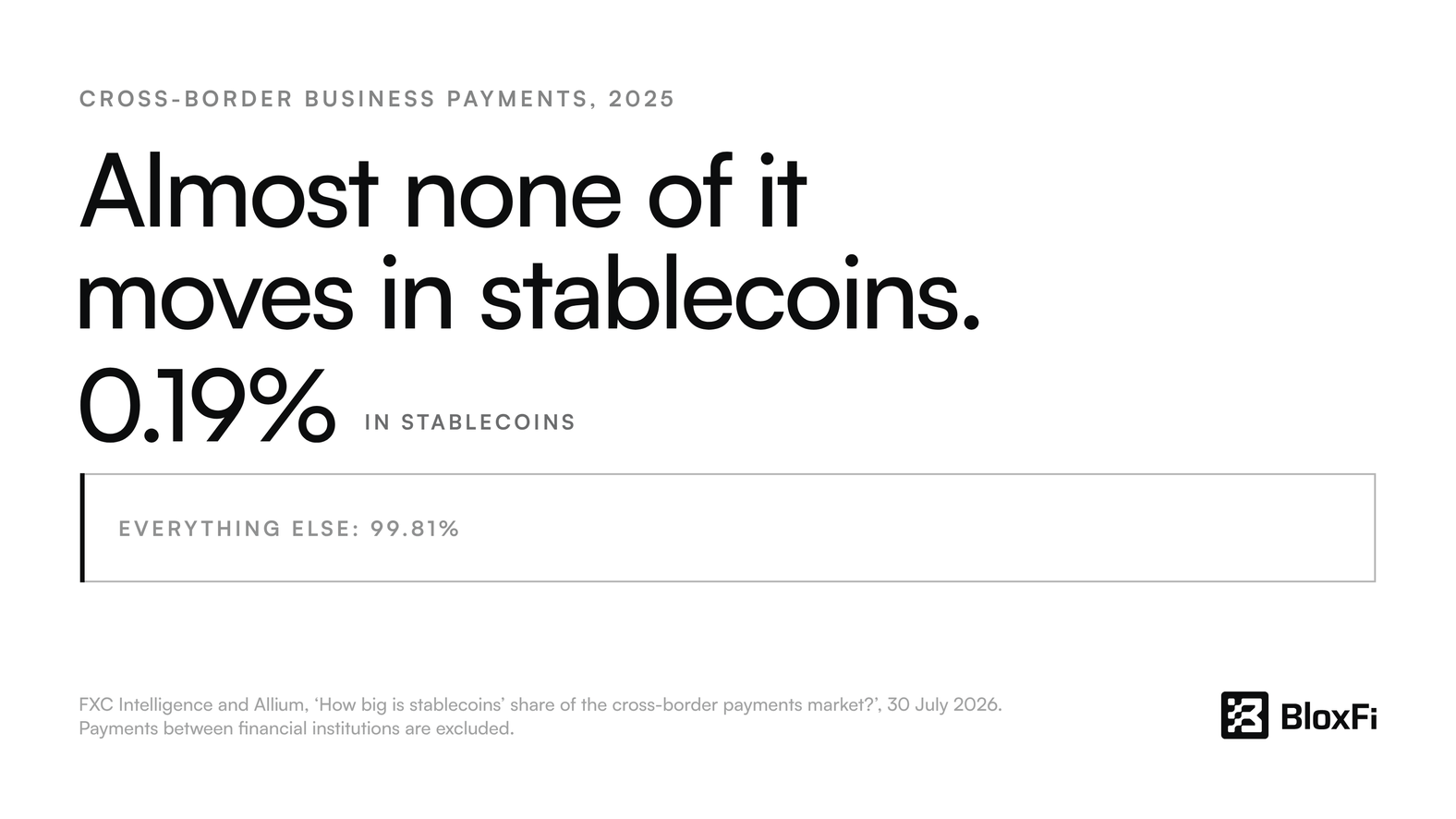
Allium's count for January to August 2026 puts stablecoin payments at $401bn to $527bn, with businesses receiving 58% to 64% of them. Two details matter for anyone planning cross-border use. About 61% of the payment volume Allium could place geographically was domestic. And on a joint estimate by FXC Intelligence and Allium, stablecoins carried 0.19% of cross-border business-to-business payment volume in 2025.
So the interest is real and growing, and the cross-border business payment, the use most often talked about, is the one furthest from scale. We think the reason is practical. Sending the token is the easy part.
A stablecoin transfer is not a completed business payment
Take a UK importer paying a supplier in the Philippines. The finance team wants the supplier paid in pesos, on a known date, with a record the auditors will accept. Using stablecoins, that payment has eight steps.
- 1Fund. The importer sends pounds from its bank account to a collection account.
- 2Convert in. The pounds are exchanged for a dollar stablecoin, usually USDT or USDC.
- 3Choose a network. The stablecoin has to sit on a blockchain that the providers at both ends support.
- 4Find liquidity. Someone must be willing to buy that stablecoin for pesos, in the size needed, at an acceptable rate.
- 5Settle. The stablecoin moves on the blockchain.
- 6Convert out. The stablecoin is exchanged for pesos.
- 7Pay out. The pesos reach the supplier's bank account through a local payment system.
- 8Record. Both companies match the payment to an invoice, with the rates and fees that applied.
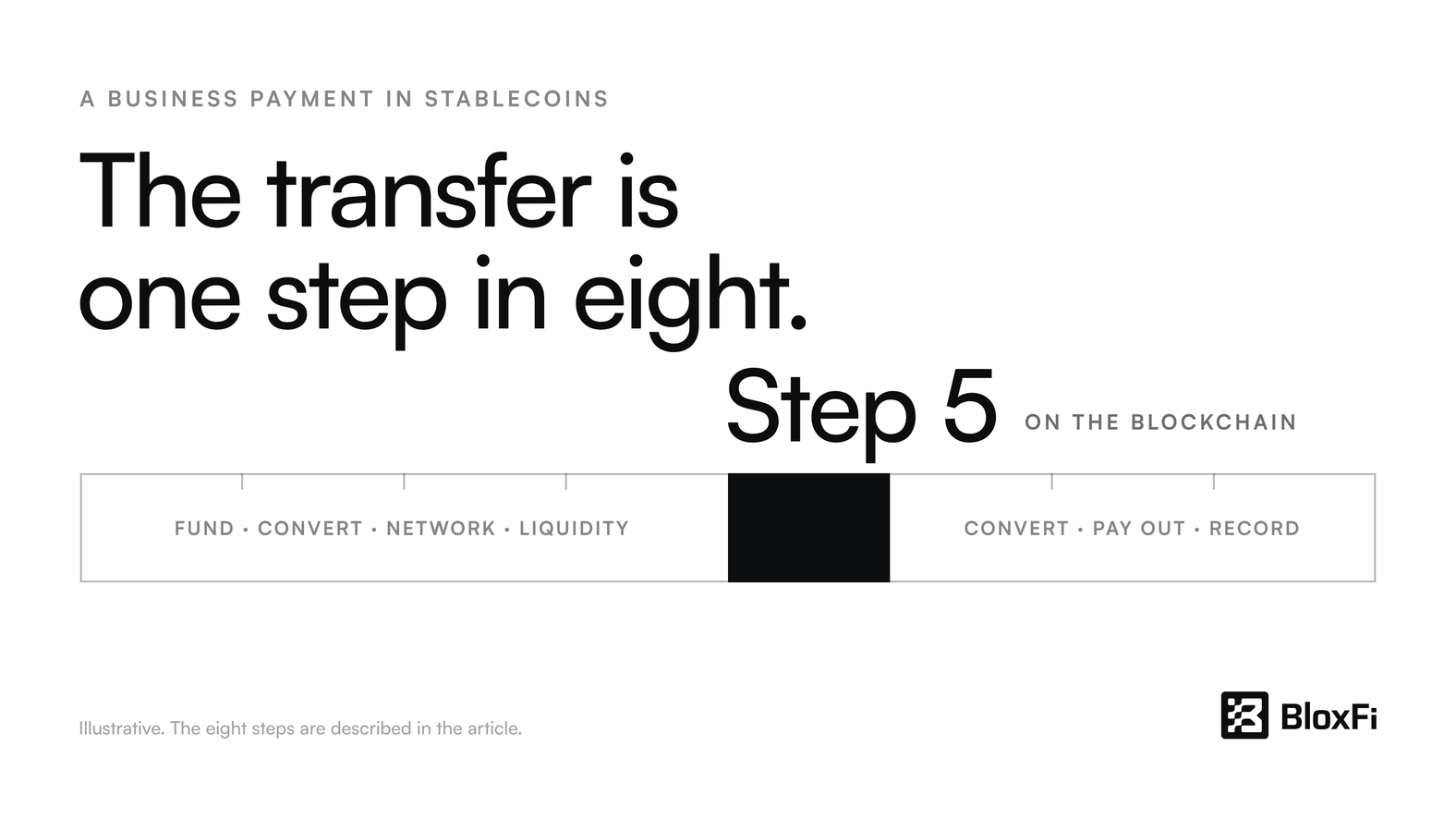
Only step five happens on a blockchain. The other seven depend on banks, payment providers, exchanges and compliance teams, each with its own onboarding, cut-off times and pricing.
Federal Reserve staff made the same point in a March 2026 note: "While a payment stablecoin may eliminate some costs associated with cross-border payments, it does not eliminate all costs." The note adds that "there may be greater 'on-ramp' and 'off-ramp' costs associated with exchanging payment stablecoins for fiat currency."
There is a useful comparison with the system stablecoins are meant to improve. Swift reports that 75% of payments on its network reach the beneficiary bank within ten minutes, and that around 80% of total processing time is spent after that, in what it calls the last mile. In both models the transfer between institutions is the quick part. The time goes at the ends: checks, currency conversion and crediting the account. Stablecoins shorten the middle, which was already short.
Fragmented stablecoin payment infrastructure
A dollar stablecoin is not one thing in one place. The Bank for International Settlements notes in its 2026 annual report that "a coin on Ethereum is not equivalent to a coin of the same name on Solana", because the two sit on separate ledgers. A supplier's provider may accept one network and not another. Moving between them takes a conversion or a transfer service, and another fee. We covered this in One digital dollar, many ledgers.
The providers are just as spread out. One may collect local currency in Europe, a second may hold the stablecoin liquidity, and a third may pay out in Asia. Each needs its own contract, onboarding and technical integration. A business that wants five payout countries can end up managing five relationships and five sets of reports before it has sent a payment.
Stablecoin liquidity and the conversion problem
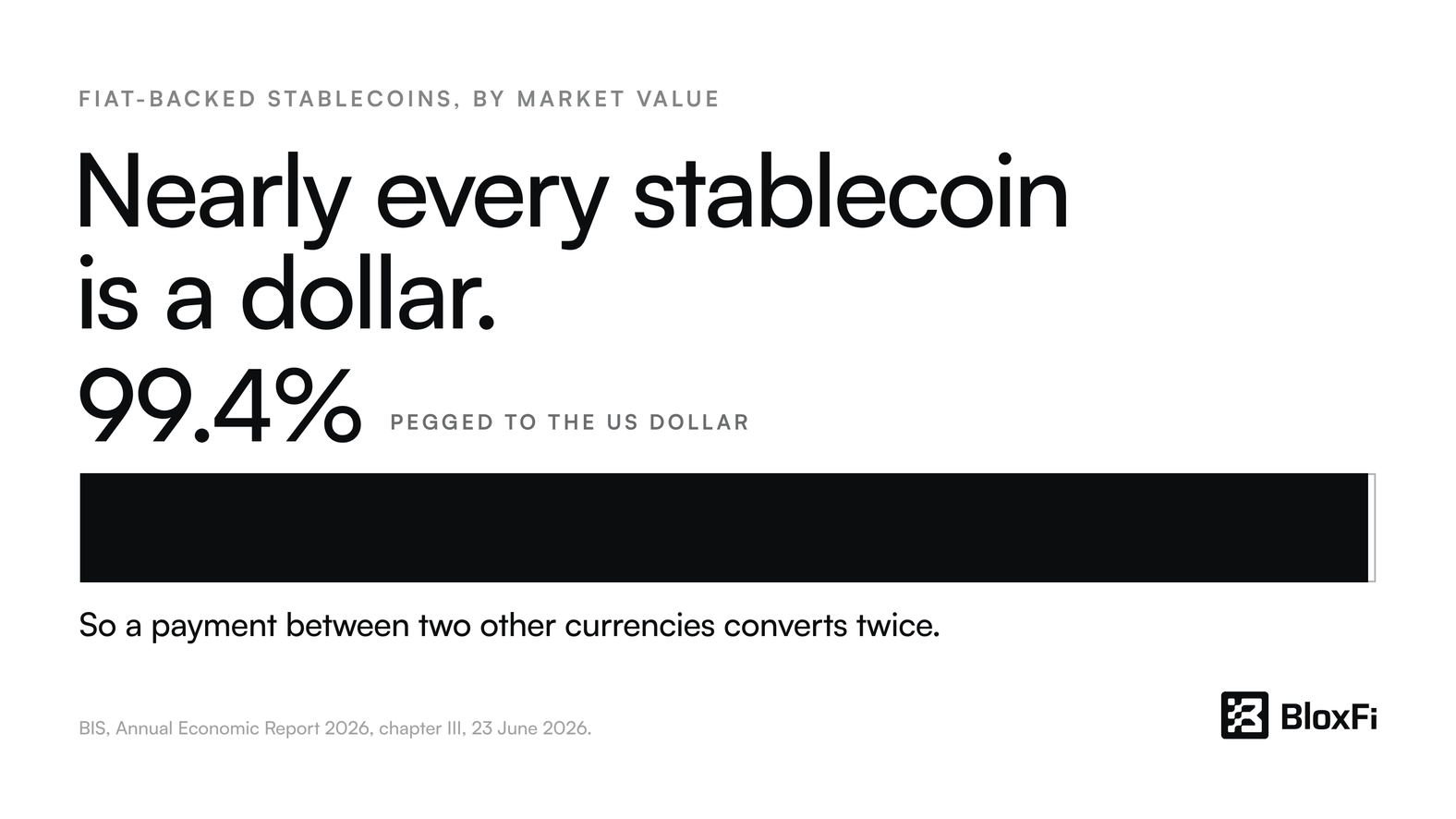
Almost all stablecoins are dollars. The BIS puts the share of fiat-backed stablecoins pegged to the US dollar at 99.4% by market value. A payment between two other currencies therefore converts twice, into dollars and out again, and each conversion needs a counterparty.
A BIS working paper published in October 2026 compared banks, fintech transfer firms and stablecoins on cost. Its authors conclude that "stablecoins are not a panacea for frictions in cross-border payments". Converting between fiat currencies and stablecoins still relies on "crypto exchanges and other intermediaries", and "liquidity between US dollar stablecoins and non-US currencies is generally very thin". Recipients "may also have to wait for stablecoin conversion and bank processing before they can access the funds".
The same paper shows why businesses keep looking. In its small sample of bank transfers, currency markups ranged from about 2% to 4.7%. For a $10,000 transfer from the United States through a fintech firm, median costs to developed-market currencies were around $40 to $60. The saving is there. Whether a stablecoin route captures it depends on the price of the two conversions and on how much liquidity is available that day, and both vary by provider. Our guide to stablecoin on-ramps and off-ramps explains how those conversions are priced.
Treasury visibility and reconciliation
Finance teams need to answer simple questions at any moment: what do we hold, where is it, what is in transit and what did it cost. With several providers and networks, each answer comes from a different screen. Balances sit in bank accounts, provider accounts and wallets. A single payment may produce a bank debit, two conversion records and a blockchain transaction, each with its own reference.
Matching these to one invoice is manual work unless the provider returns the rate, the fees and the final amount for the whole payment in one record. Auditors will ask for exactly that. It matters for cash planning too: money that has left the bank and not yet reached the supplier is money the treasurer can't use. We haven't found reliable public data on what this work costs, so we won't put a number on it. Any finance team that has run two payment providers side by side will recognise it.
Compliance, security and operational risk
Stablecoins don't change who is responsible for knowing the customer. They add checks. A business payment still needs identity checks on the companies involved, sanctions screening and a record of the payment's purpose. On a blockchain, the wallet addresses are screened as well.
Regulators are paying attention. The Financial Action Task Force reported in March 2026 that, on Chainalysis data, stablecoins accounted for 84% of illicit virtual asset transaction volume in 2025, and that only a limited number of jurisdictions had targeted rules in place. The Financial Stability Board's peer review of October 2025 called cross-border cooperation on crypto-asset rules "fragmented, inconsistent, and insufficient". For a business, that means the rules differ by country and are still being written.
Two things follow. A provider can supply screening and monitoring, but the legal obligations stay with the business using them. And operational risk grows with every extra provider: more accounts to secure, more people with payment authority, and more places where a payment can stall when one provider is unavailable.
What business-ready stablecoin payment infrastructure looks like
To make stablecoins practical for business operations, companies need more than access to digital wallets or blockchain networks. They need an infrastructure layer that connects the whole payment, from collection to reconciliation. Six capabilities matter, and each one answers a problem described above.
| Capability | Problem it answers | What to ask a provider |
|---|---|---|
| Local collection and local payout | Money starts and ends in bank accounts | Which currencies can you collect today, and which can you pay out? |
| Conversion with several liquidity sources | Two conversions and thin liquidity | Where does the price come from, and what happens if one source is unavailable? |
| Route comparison | Costs differ by provider, network and day | Do I see the total cost and expected delivery time before I confirm? |
| One record per payment | Reconciliation across several systems | Do I get one reference with the rate, fees and final amount? |
| Dashboard and API access | Too many integrations | Can my systems send and track payments through one connection? |
| Compliance checks inside the flow | Rules that differ by country | Which checks do you run, and which stay with me? |
How BloxFi connects the payment journey
BloxFi is built for the steps around the blockchain transfer. It is primarily a technology and connectivity platform. Clients onboard with the relevant underlying providers, and BloxFi brings those providers, corridors and transaction options together through one interface. BLOXFI LIMITED is a technology provider, not a bank.
In a cross-border payment on BloxFi, the sender pays in local currency into a local collection account or a named account. Connected providers convert the funds into USDT or USDC and settle. The funds are then converted into the recipient's currency and paid into their bank account by a local payment method. Neither the sender nor the recipient needs a crypto wallet.
That flow lines up with the gaps described above.
Collection and payout: local in, local out, so both companies keep working in their own currency and their own bank account.
Liquidity and conversion: smart routing compares eligible routes across connected providers on total cost, available liquidity and estimated delivery time. Larger trades can go through the OTC desk.
Visibility: the quote shows the exchange rate, charges and settlement amount before confirmation, and each payment is tracked through to settlement.
Integration: one dashboard or one API in place of a separate integration for each provider, with a white-label option for platforms serving their own customers.
Compliance: BloxFi coordinates onboarding and applicable checks, including on-chain checks, alongside the relevant service entity and providers. Clients keep their own legal and regulatory obligations.
None of this removes the underlying work. Conversion still costs money, and payout times still depend on the local payment system. Availability, rails, limits and timing are confirmed per client following KYB and compliance review. What changes is how many providers a business has to connect and reconcile to get one payment done.
What to check before adopting stablecoins for business payments
- 1Map the full payment, from the bank account it leaves to the bank account it reaches, and name who handles each step.
- 2Ask for the total cost of a real payment in your corridor, including both conversions and the payout fee.
- 3Check collection coverage and payout coverage separately. They are rarely the same list.
- 4Confirm which stablecoins and networks your counterparties and their providers accept.
- 5Ask what happens when a provider or a route is unavailable.
- 6See a sample payment record and test it against your accounting system.
- 7Get in writing which compliance checks the provider runs and which stay with you.
- 8Start with one corridor and one supplier before moving volume.
Frequently asked questions
What is stablecoin payment infrastructure?
It is the set of systems that connects a stablecoin transfer to the banking system at both ends: local collection, conversion between fiat currency and stablecoins, access to liquidity, local payout, tracking and compliance checks.
Are stablecoin payments cheaper than bank transfers for businesses?
They can be. It depends on the corridor, the amount and the cost of converting in and out. The BIS working paper cited above found bank currency markups of about 2% to 4.7% in a small sample. It also found that the intermediaries needed to convert stablecoins can add to the total cost.
Does the recipient need a crypto wallet?
Not necessarily. Where a provider handles the conversion and the local payout, the recipient is paid in local currency into a bank account.
Which stablecoins do businesses use for cross-border payments?
Mostly dollar stablecoins such as USDT and USDC. The BIS reports that 99.4% of fiat-backed stablecoins by market value are pegged to the US dollar.
Who is responsible for compliance in a stablecoin payment?
Each regulated provider in the chain runs its own checks. The business making the payment keeps its own legal and regulatory obligations.
The payment is the whole journey
Stablecoins change how money moves between institutions. They don't collect it, convert it, deliver it to a bank account or account for it. Those jobs decide whether a business payment arrives on time and at a known cost, and today they are spread across many providers. The companies that get value from stablecoins first will probably be the ones that sort out that infrastructure before they send their first payment.
Sources
McKinsey & Company and Artemis Analytics, "Stablecoins in payments: What the raw transaction numbers miss", 18 February 2026. Payment estimates annualised from December 2025 activity.
Allium, "State of Stablecoins and Payments: September 2026", 15 September 2026. Data for January to August 2026.
FXC Intelligence and Allium, "How big is stablecoins' share of the cross-border payments market? The state of adoption in numbers", 30 July 2026. Data for 2025.
Board of Governors of the Federal Reserve System, "Payment Stablecoins and Cross Border Payments: Benefits and Implications for Monetary Policy Implementation", FEDS Notes, 30 March 2026.
Swift, "Unlocking last mile speed in cross-border payments", 20 July 2026.
Bank for International Settlements, "Annual Economic Report 2026, chapter III: Anchoring trust in money: innovation beyond stablecoins", 23 June 2026.
Bank for International Settlements, "Competing rails for crossborder payments: banks, fintechs, and stablecoins", BIS Working Paper 1385, 19 October 2026.
Financial Action Task Force, "Targeted Report on Stablecoins and Unhosted Wallets: Peer-to-Peer Transactions", 3 March 2026. The 84% figure is Chainalysis data cited by the FATF.
Financial Stability Board, "Thematic Review on FSB Global Regulatory Framework for Crypto-asset Activities", Peer review report, 16 October 2025.